Shifting Signs
25 April to 6 June 2026 ⟶ Galerie Georg Nothelfer
Exhibition view. Photo: Katrin Rother

Exhibition view. Photo: Katrin Rother
László Lakner, Duchamp, 1983, Oil on canvas, 195 x 175 cm

László Lakner, Duchamp, 1983, Oil on canvas, 195 x 175 cm
Exhibition view. Photo: Katrin Rother

Exhibition view. Photo: Katrin Rother
László Lakner, After Marcel - After the Large Glass, 1979, Oil on Canvas, 200 x 150 cm

László Lakner, After Marcel - After the Large Glass, 1979, Oil on Canvas, 200 x 150 cm
Exhibition view. Photo: Katrin Rother
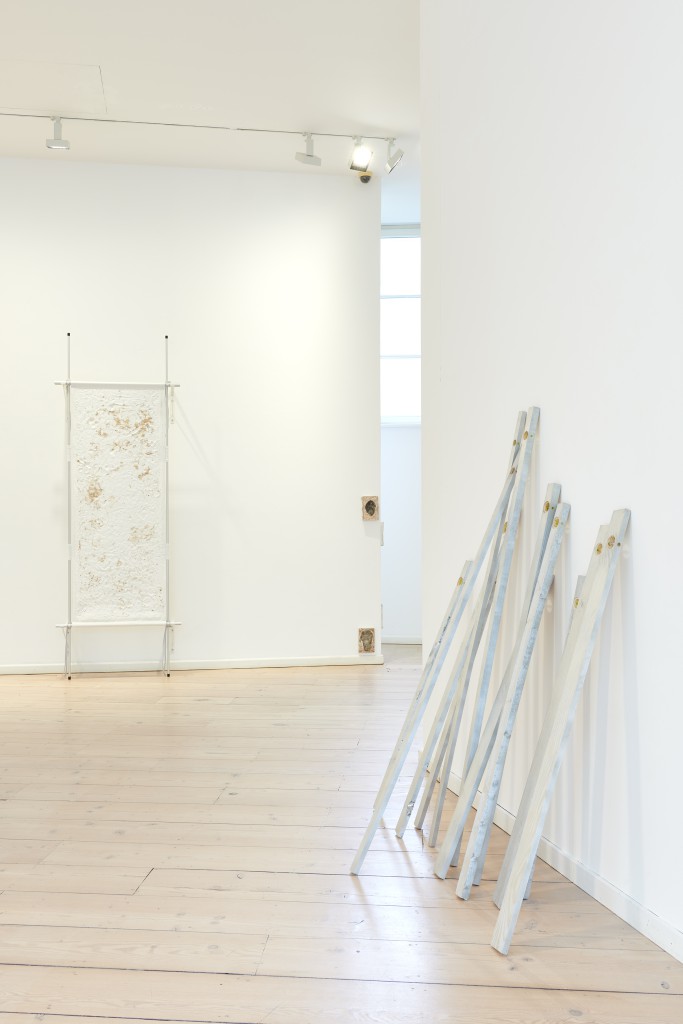
Exhibition view. Photo: Katrin Rother
Stella Geppert, Schneeliege, 2026, Silicone on linen, 195 x 75 / 260 x 100 x 35 cm (including scaffolding)
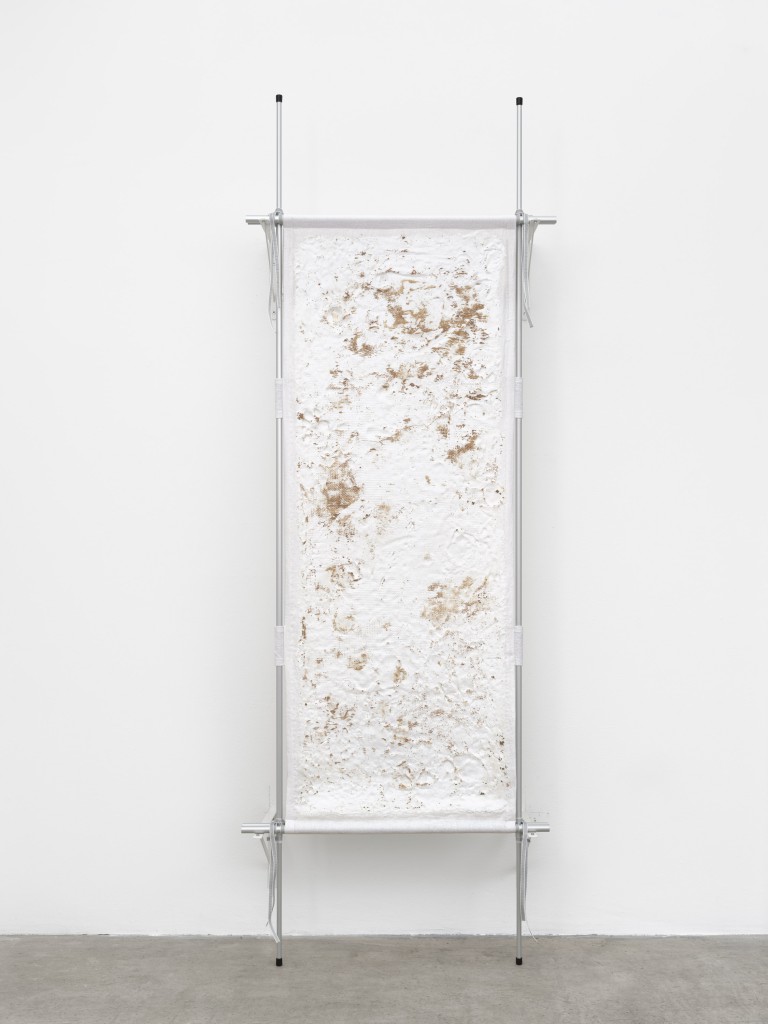
Stella Geppert, Schneeliege, 2026, Silicone on linen, 195 x 75 / 260 x 100 x 35 cm (including scaffolding)
Stella Geppert, ÉGALITÉ - The Turn of the Dragonflies, 1 x 12
2011, 12 wooden poles, 12 glas, lacquered spirit levels, different sizes:
L: 80 - 120 cm / B: 5 cm - 7 cm / T: 2 cm x 3 cm. Courtesy the artist and Galerie Nothelfer

Stella Geppert, ÉGALITÉ - The Turn of the Dragonflies, 1 x 12
2011, 12 wooden poles, 12 glas, lacquered spirit levels, different sizes:
L: 80 - 120 cm / B: 5 cm - 7 cm / T: 2 cm x 3 cm. Courtesy the artist and Galerie Nothelfer
Exhibition view. Photo: Katrin Rother
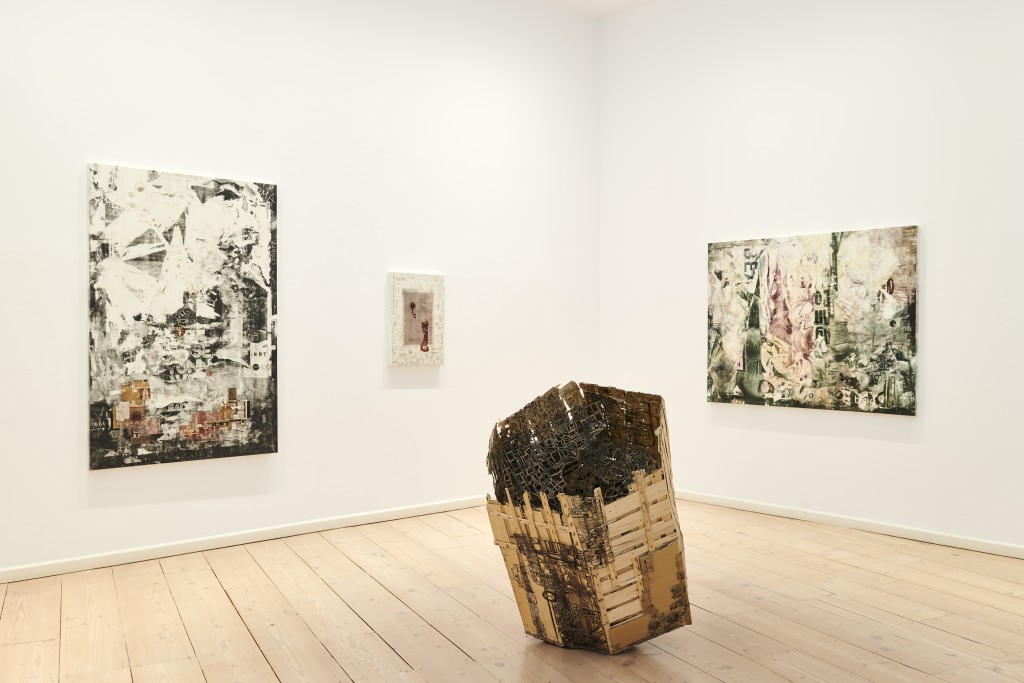
Exhibition view. Photo: Katrin Rother
Jenny Michel, Lunatic Landscape- SE-GHT, 2026, Rotogravure ink on various papers, acrylic glue on canvas, 180 x 120 cm. Courtesy the Artist and Galerie Nothelfer

Jenny Michel, Lunatic Landscape- SE-GHT, 2026, Rotogravure ink on various papers, acrylic glue on canvas, 180 x 120 cm. Courtesy the Artist and Galerie Nothelfer
Jenny Michel, Semiosphere #1, 2026, intaglio ink, print, found materials on various papers, acrylic glue on canvas, 70 x 50 cm

Jenny Michel, Semiosphere #1, 2026, intaglio ink, print, found materials on various papers, acrylic glue on canvas, 70 x 50 cm
Jenny Michel, Paradise Vehicle in Decay #1 (Moon Capsule), 2015,
Mixed media, 125 x 85 x 75 cm
Mixed media, 125 x 85 x 75 cm

Jenny Michel, Paradise Vehicle in Decay #1 (Moon Capsule), 2015,
Mixed media, 125 x 85 x 75 cm
Mixed media, 125 x 85 x 75 cm
Exhibition view. Photo: Katrin rother

Exhibition view. Photo: Katrin rother
Jenny Michel, Lunatic Landscape Gration, 2026, Mixed media,
130 x 170 cm
130 x 170 cm

Jenny Michel, Lunatic Landscape Gration, 2026, Mixed media,
130 x 170 cm
130 x 170 cm
Jenny Michel, Plant demiurgi signs#2, 2023, Mixed media, 70 x 50 cm

Jenny Michel, Plant demiurgi signs#2, 2023, Mixed media, 70 x 50 cm
Jenny Michel, Plant demiurgi signs#1, 2023, Mixed media, 70 x 50 cm

Jenny Michel, Plant demiurgi signs#1, 2023, Mixed media, 70 x 50 cm
Jenny Michel, Plant demiurgi signs #3, 2023, Mixed media, 70 x 50 cm

Jenny Michel, Plant demiurgi signs #3, 2023, Mixed media, 70 x 50 cm
Exhibition view. Photo: Katrin Rother

Exhibition view. Photo: Katrin Rother
Elmira Iravanizad, Day 4, 2025 Oil on Canvas, 100 x 80 cm

Elmira Iravanizad, Day 4, 2025 Oil on Canvas, 100 x 80 cm
Elmira Iravanizad, Day 2, 2025, Oil on canvas, 100 x 80 cm

Elmira Iravanizad, Day 2, 2025, Oil on canvas, 100 x 80 cm
Elmira Iravanizad, Object No. 65, 2023, Metal and wood, 8 x 16 x 40 cm

Elmira Iravanizad, Object No. 65, 2023, Metal and wood, 8 x 16 x 40 cm
Exhibition view. Photo: Katrin Rother

Exhibition view. Photo: Katrin Rother
Exhibition view. Photo: Katrin Rother

Exhibition view. Photo: Katrin Rother
László Lakner, Livre Imaginaire, 1991, Book-object, 25,5 x 38,5 x 2 cm

László Lakner, Livre Imaginaire, 1991, Book-object, 25,5 x 38,5 x 2 cm
László Lakner, Paul Cézanne Briefentwurf, 1976, Acrylic on canvas, 200 x 150 cm. Courtesy Galerie Nothelfer

László Lakner, Paul Cézanne Briefentwurf, 1976, Acrylic on canvas, 200 x 150 cm. Courtesy Galerie Nothelfer
Exhibition view. Photo: Katrin Rother

Exhibition view. Photo: Katrin Rother
Stella Geppert, Constitutions of the bodies (Seaside drawings), 2022, Mixed media, 200 x 100 cm

Stella Geppert, Constitutions of the bodies (Seaside drawings), 2022, Mixed media, 200 x 100 cm
Stella Geppert, Earthphone, 2025/2026, Graphite, 16 x 8 x 6,5 cm

Stella Geppert, Earthphone, 2025/2026, Graphite, 16 x 8 x 6,5 cm
Exhibition view. Photo: Katrin Rother

Exhibition view. Photo: Katrin Rother
Stella Geppert, Tiger Lungs, 2024, Charcoal on canvas, 35 x 35 cm SOLD

Stella Geppert, Tiger Lungs, 2024, Charcoal on canvas, 35 x 35 cm SOLD
Exhibition view. Photo: Katrin Rother

Exhibition view. Photo: Katrin Rother
Adochi, Leichte Erde I, 1986, glue paint on canvas, 175 x 155 cm

Adochi, Leichte Erde I, 1986, glue paint on canvas, 175 x 155 cm
Exhibition view. Photo: Katrin Rother

Exhibition view. Photo: Katrin Rother
Adochi, Lerba, 1986, Mixed media on wood, 178 x 19 x 6 cm
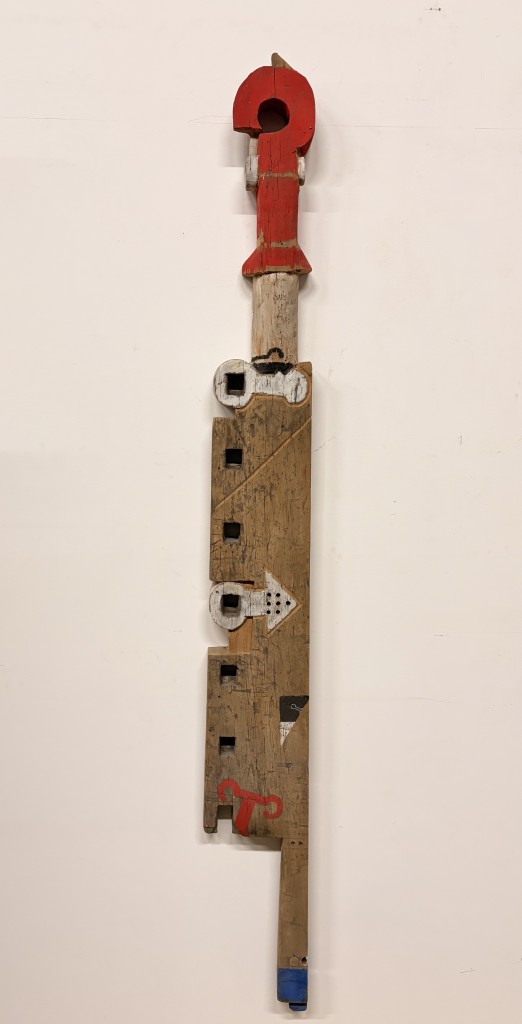
Adochi, Lerba, 1986, Mixed media on wood, 178 x 19 x 6 cm
Adochi, Untitled (Fragment), 1986, Sandstone, 42 x 18 x 10 cm. Courtesy Galerie Nothelfer

Adochi, Untitled (Fragment), 1986, Sandstone, 42 x 18 x 10 cm. Courtesy Galerie Nothelfer
Exhibition view. Photo: Katrin Rother

Exhibition view. Photo: Katrin Rother
Adochi, Aus dem Tief Unten, 1986, glue paint on canvas, 175 x 155 cm

Adochi, Aus dem Tief Unten, 1986, glue paint on canvas, 175 x 155 cm
Adochi, O.T., 1986, Leimfarbe auf Leinwand, 175 x 155 cm

Adochi, O.T., 1986, Leimfarbe auf Leinwand, 175 x 155 cm
Exhibition view. Photo: Katrin Rother

Exhibition view. Photo: Katrin Rother
Adochi, Mioritische Form, 1988, glue paint on canvas, 100 x 80 cm

Adochi, Mioritische Form, 1988, glue paint on canvas, 100 x 80 cm
Stella Geppert, Tierpark Berlin, 2026, color photography. Courtesy the artist and Galerie Nothelfer

Stella Geppert, Tierpark Berlin, 2026, color photography. Courtesy the artist and Galerie Nothelfer
Duration: April 25 - June 6 2026
Opening: April 24, 6 - 9 pm
Artist Talk: May 2, 2 pm
Opening hours:
Wed - Fr, 12 - 7 pm
Sat, 12 - 6 pm
Special opening hours during Berlin Gallery Weekend (May 1-3)
Fri, 12 - 9 pm
Sat + Sun, 11 am - 6 pm
If in the 19th century the passage through the world still appeared to the poet as one through dark “forests of symbols” (Charles Baudelaire), the linguistics and semiotics of the 20th century thoroughly illuminated and combed through these forests, organizing and classifying them, and in the process did away with the notion of primordial, natural meanings. The “thicket of signs” (Aleida Assmann) that surrounds us reveals itself in this light as a complex “network of sign systems” (Umberto Eco), and our everyday life practice as a culturally coded and internalized or incorporated practice of signs.
Yet it is not only we who move within a world of signs; the signs themselves are constitutively mobile. They acquire their meaning only as effects of differentiations, references, and continual displacements. Within these dynamic structures of differentiation, sign systems are at best metastable; their order is merely a temporary, changeable one and thus always precarious. New signs emerge and alter the meaning of the old ones, others disappear, cultural codes can be lost or overwritten, and entire sign systems can thereby become unreadable.
In the globalized and digitalized everyday world of our present, the mobility of signs can be observed in a continual and accelerated transfer of signs: between different (analog and digital) media, between cultures and their differently coded sign systems and sign practices, between the digitally available archives of historical sign production and the imagination of future signs, as well as between visible and invisible sign systems—for instance, the interface of our digital text-image world and the codes that generate it.
Art, too, takes part in this transfer of signs: the exhibition Shifting Signs presents, with Adochi (*1954), Stella Geppert (*1967), Elmira Iravanizad (*1987), László Lakner (*1936), and Jenny Michel (*1975), five artistic positions from different generations whose works engage in various ways with sign systems and their dynamic processes of displacement. In their exploratory character, the works shown in the exhibition follow the movements of signs across times, media, cultures, and practices, record them, reflect on them, and render them productive in the design of new constellations of signs.
At the center of László Lakner’s artistic practice are transfers between the fundamental sign systems of “writing” and “image.” Handwriting in particular functions as a medium of boundary crossings: on the one hand, its individual character can become so dominant that its functioning as a sign is disrupted, leaving only a scribble, an idiosyncratic gestural script that bears witness to the movement of an “awkward” hand (Roland Barthes). On the other hand, Lakner questions its signature character through the appropriative transfer of foreign handwritings—mostly by artists and writers (Paul Celan, Paul Klee, Paul Cézanne, among others)—into his own images, and through the shift of context simultaneously makes their genuine graphic quality visible.
Stella Geppert likewise focuses in her works on the bodily-gestural dimension of sign production as a performative act. The physical and embodied generation of signs becomes apparent, for example, in her performatively created drawings, which register the gestural communication of participants as charcoal traces on large-format sheets of paper. If viewing the image thus becomes a retracing of graphic traces, the artist, in her most recent intervention in urban space—where she leaves marks using the cast of a leopard’s paw—invites people to take up the archaic practice of tracking again, setting them in motion and leading them, within the urban jungle, both onto a false trail and the right one.
Neither linear writing nor gestural trace seem to account for the enigmatic forms that appear in a palimpsest-like, collage-like superimposition in the paintings of Adochi, where, through their chromatic differentiation, they generate a complex pictorial space while simultaneously pointing, as individual, distinct signs, toward the unknown. But what kind of signs are these? Archaic symbols, technical pictograms, mathematical operators, or simply ornaments, perhaps inspired by the folk art of his Romanian homeland? These questions, and the ongoing attempts at decipherment in viewing the images, lead—without any prospect of resolution—ever deeper into the machinery of the paintings, which construct their own opaque cosmos of signs.
The collages and sculptures of Elmira Iravanizad likewise appear closed at first glance, with their fragmented forms that partly resemble finds from archaeological excavations and partly enigmatic hybrids between monument and utilitarian object. As silent witnesses, the fragments point to the loss of a context, yet at the same time, freed from their original configuration, they can be understood as building blocks of new sign systems. In her collages, Iravanizad collects remnants of paper works—small scraps—archives them, and through their arrangement in a line-based system creates new relations and thus new possibilities of meaning. Her objects, too, raise the question of an original context of meaning and function, as well as that of possibilities for new uses.
Finally, the fragility of sign systems and their superimpositions are also at the center of the works of Jenny Michel. The complex network of heterogeneous sign systems that covers—and thereby produces—our world is condensed by her in individual images and installations into palimpsests: circuit diagrams and maps, circuit boards and wires, botanical illustrations, complex cellular structures, the analog and the digital, the organic and the technical—all of this and more seems to overlap here like layers of sediment. In the sense of a speculative archaeology of the future, her works thus open up the possibility of reflecting on what of the signs of our present will remain, what future remnants, what cryptic fragments and ruins we will leave behind.
(Text by Justus Beyerling)
Opening: April 24, 6 - 9 pm
Artist Talk: May 2, 2 pm
Opening hours:
Wed - Fr, 12 - 7 pm
Sat, 12 - 6 pm
Special opening hours during Berlin Gallery Weekend (May 1-3)
Fri, 12 - 9 pm
Sat + Sun, 11 am - 6 pm
If in the 19th century the passage through the world still appeared to the poet as one through dark “forests of symbols” (Charles Baudelaire), the linguistics and semiotics of the 20th century thoroughly illuminated and combed through these forests, organizing and classifying them, and in the process did away with the notion of primordial, natural meanings. The “thicket of signs” (Aleida Assmann) that surrounds us reveals itself in this light as a complex “network of sign systems” (Umberto Eco), and our everyday life practice as a culturally coded and internalized or incorporated practice of signs.
Yet it is not only we who move within a world of signs; the signs themselves are constitutively mobile. They acquire their meaning only as effects of differentiations, references, and continual displacements. Within these dynamic structures of differentiation, sign systems are at best metastable; their order is merely a temporary, changeable one and thus always precarious. New signs emerge and alter the meaning of the old ones, others disappear, cultural codes can be lost or overwritten, and entire sign systems can thereby become unreadable.
In the globalized and digitalized everyday world of our present, the mobility of signs can be observed in a continual and accelerated transfer of signs: between different (analog and digital) media, between cultures and their differently coded sign systems and sign practices, between the digitally available archives of historical sign production and the imagination of future signs, as well as between visible and invisible sign systems—for instance, the interface of our digital text-image world and the codes that generate it.
Art, too, takes part in this transfer of signs: the exhibition Shifting Signs presents, with Adochi (*1954), Stella Geppert (*1967), Elmira Iravanizad (*1987), László Lakner (*1936), and Jenny Michel (*1975), five artistic positions from different generations whose works engage in various ways with sign systems and their dynamic processes of displacement. In their exploratory character, the works shown in the exhibition follow the movements of signs across times, media, cultures, and practices, record them, reflect on them, and render them productive in the design of new constellations of signs.
At the center of László Lakner’s artistic practice are transfers between the fundamental sign systems of “writing” and “image.” Handwriting in particular functions as a medium of boundary crossings: on the one hand, its individual character can become so dominant that its functioning as a sign is disrupted, leaving only a scribble, an idiosyncratic gestural script that bears witness to the movement of an “awkward” hand (Roland Barthes). On the other hand, Lakner questions its signature character through the appropriative transfer of foreign handwritings—mostly by artists and writers (Paul Celan, Paul Klee, Paul Cézanne, among others)—into his own images, and through the shift of context simultaneously makes their genuine graphic quality visible.
Stella Geppert likewise focuses in her works on the bodily-gestural dimension of sign production as a performative act. The physical and embodied generation of signs becomes apparent, for example, in her performatively created drawings, which register the gestural communication of participants as charcoal traces on large-format sheets of paper. If viewing the image thus becomes a retracing of graphic traces, the artist, in her most recent intervention in urban space—where she leaves marks using the cast of a leopard’s paw—invites people to take up the archaic practice of tracking again, setting them in motion and leading them, within the urban jungle, both onto a false trail and the right one.
Neither linear writing nor gestural trace seem to account for the enigmatic forms that appear in a palimpsest-like, collage-like superimposition in the paintings of Adochi, where, through their chromatic differentiation, they generate a complex pictorial space while simultaneously pointing, as individual, distinct signs, toward the unknown. But what kind of signs are these? Archaic symbols, technical pictograms, mathematical operators, or simply ornaments, perhaps inspired by the folk art of his Romanian homeland? These questions, and the ongoing attempts at decipherment in viewing the images, lead—without any prospect of resolution—ever deeper into the machinery of the paintings, which construct their own opaque cosmos of signs.
The collages and sculptures of Elmira Iravanizad likewise appear closed at first glance, with their fragmented forms that partly resemble finds from archaeological excavations and partly enigmatic hybrids between monument and utilitarian object. As silent witnesses, the fragments point to the loss of a context, yet at the same time, freed from their original configuration, they can be understood as building blocks of new sign systems. In her collages, Iravanizad collects remnants of paper works—small scraps—archives them, and through their arrangement in a line-based system creates new relations and thus new possibilities of meaning. Her objects, too, raise the question of an original context of meaning and function, as well as that of possibilities for new uses.
Finally, the fragility of sign systems and their superimpositions are also at the center of the works of Jenny Michel. The complex network of heterogeneous sign systems that covers—and thereby produces—our world is condensed by her in individual images and installations into palimpsests: circuit diagrams and maps, circuit boards and wires, botanical illustrations, complex cellular structures, the analog and the digital, the organic and the technical—all of this and more seems to overlap here like layers of sediment. In the sense of a speculative archaeology of the future, her works thus open up the possibility of reflecting on what of the signs of our present will remain, what future remnants, what cryptic fragments and ruins we will leave behind.
(Text by Justus Beyerling)